

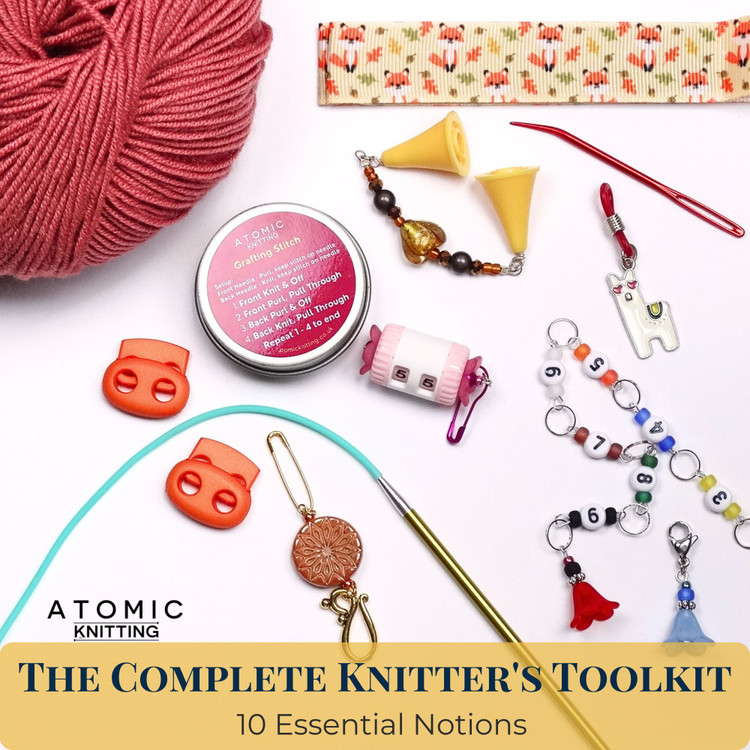
The Complete Knitter's Toolkit: 10 Essential Notions You Didn't Know You Needed
Posted by Emma | 15 Mar 2026 on 15th Mar 2026
Most knitters start the same way.
A pair of needles. A ball of yarn. Maybe a pattern.
And for a while, that's enough.
Then you knit something with shaping, or lace, or a complicated repeat, and you realise that needles and yarn are just the beginning. The knitters who make things look effortless? They have a toolkit.
Not an expensive one. Not a complicated one. Just a small collection of notions that quietly solve the problems most of us didn't even know we had until we were three rows into the wrong stitch count at 11pm.
Here are ten of them.
1. Stitch Markers
Let's start with the obvious one - but don't skip this section, because most knitters are using the wrong type for at least one of their projects.
Stitch markers sit on your needle and mark a specific point in your knitting. The beginning of a round. A pattern repeat. Where your increases start. Where your decreases end.
Without them, you count. And count again. And probably count a third time to be sure.
With them, you just knit to the marker, do the thing, and move on.
The type matters though. Ring stitch markers work brilliantly for marking rounds in circular knitting. Removable markers can be clipped onto a specific stitch rather than sitting on the needle — essential for crochet and useful for knitting too. Lace ring markers are smaller and snag-free so they glide past delicate yarn without catching.
If you're only using the basic split rings that come in a starter kit, it's worth exploring what else is out there. The right marker for the right project makes a surprising difference.
2. A Row Counter
You think you'll remember what row you're on.
You will not remember what row you're on.
A row counter is the single most effective way to remove that particular source of knitting anxiety. Click it after every row and it keeps track so you don't have to.
The row counter chain is especially popular because it attaches directly to your knitting — it goes where the project goes, so there's no hunting around for it when you pick up your needles. The counting bracelet is another option that many knitters love for its elegance: beautiful beads that slide along to count rows, worn on your wrist so it's always to hand.
For a deeper look at why row counters are worth it, we've written a whole post about them: Row Counters — The Secret to Stress-Free Knitting.
3. A Magnetic Pattern Guide
If you've ever lost your place in a chart, you'll understand why this exists.
A magnetic pattern guide is a set of two magnetic strips that sit either side of your pattern, holding a line marker exactly where you are. Move it down row by row and you never lose your place again — even if you put the project down for a week and come back to it.
It works on printed patterns, knitting books, and even cross-stitch charts. The magnets are strong enough to stay put but won't damage pages.
For anyone who knits from charts or follows complex written repeats, this is genuinely one of those tools that makes you wonder how you managed without it.
4. DPN Holders
If you knit socks, mittens, or anything on double-pointed needles, you will at some point put your project down and have all four needles escape in different directions while the stitches slide off the end.
DPN holders stop this. They clip or cap onto the ends of your DPNs to keep everything in place when your project is at rest in your bag. Simple, inexpensive, and one of those things you kick yourself for not buying sooner.
5. Point Protectors
Similar principle, different application.
Point protectors fit over the tips of your straight or circular needles to stop stitches slipping off when you're not knitting. Essential for travel, great for project bags, and a small mercy when you're mid-row and need to put everything down in a hurry.
They also protect your needle tips from damage when you're rummaging around in your bag. A small thing that prevents a frustrating one.
6. A Knitting Stitch Cord
Also called stitch keeping cord or lifeline cord.
A knitting stitch cord is a flexible cord you thread through your live stitches to hold them safely when you need to take them off the needle — for trying something on, for holding while you work another section, or as a rescue lifeline in lace knitting so you have a safe row to rip back to.
Pair it with a stitch locker to secure the ends and your stitches aren't going anywhere.
If you've ever had to frog a complex piece and lost stitches in the process, this is the tool that prevents it happening again.
7. A Tape Measure
Yes, really.
A tape measure is on this list not because you don't know tape measures exist, but because so many knitters are using the wrong kind, or worse — not measuring at all.
Gauge swatches need measuring. Sleeve lengths need measuring. Body lengths, neck depths, cuff widths — all of it.
A small, retractable tape measure that lives in your project bag means you actually do the measuring, rather than making hopeful guesses based on how it looks. And it means your finished knitting fits.
8. Needle Huggers
A newer addition to many knitters' toolkits and worth knowing about.
Needle huggers are small silicone or rubber bands that wrap around the join between your needle tip and cable on circular needles, preventing that infuriating moment where stitches slip into the join while you're knitting. They also work to bundle and organise spare needles neatly.
Once you've knitted with them in place, you'll notice how much smoother the whole experience is. No more pausing to push stitches back past the join.
9. A Portuguese Knitting Pin
This one might be new to you — and it's genuinely worth knowing about, even if you don't knit Portuguese style.
A Portuguese knitting pin clips to your collar, cardigan, or a lanyard and holds your yarn at a consistent tension as you knit. The yarn feeds through a loop in the pin, which means your tension stays even without you having to think about it.
For knitters who struggle with consistent tension, sore hands, or repetitive strain from gripping yarn, it can be a real game-changer. And they're beautiful — ours come in a range of designs with gemstone beads and charms, so they double as a piece of jewellery when you're not at the needles.
We've written a full post on how they work: Portuguese Knitting Pins — The Secret to Easier, More Comfortable Knitting.
10. A Grafting Stitch Instruction Tin
Every sock knitter needs this.
The Kitchener stitch (grafting) is one of those techniques that many knitters look up every single time. Not because it's impossibly hard — but because it's done infrequently enough that the exact sequence doesn't stick.
Our Grafting Stitch Instruction Tin has the complete step-by-step instructions printed on the inside of the lid, so they're always to hand at the exact moment you need them. It also doubles as a small notions tin for keeping your finishing tools — tapestry needle, scissors, stitch markers — all in one place.
It's one of those small things that makes finishing a project feel calm rather than fraught.
If you'd like a full guide to working the Kitchener stitch, we've covered it in detail here: The Kitchener Stitch — A Beginner's Guide to Grafting.
Shop the Grafting Stitch Instruction Tin
Start Small, Notice the Difference
You don't need all ten of these at once.
Pick one or two that solve the problem you encounter most often. Maybe that's losing count of rows. Maybe it's stitches sliding off DPNs. Maybe it's tension issues that leave you frustrated with your own knitting.
Start there. Add to your toolkit gradually. And notice how much calmer and more enjoyable your knitting becomes when the small frictions are removed.
The yarn and the needles are the magic. Everything else is just making sure nothing gets in the way of it.
Browse all Knitting Accessories
Atomic Knitting has been designing and making stitch markers, row counters and knitting accessories in South Wales since 2006. Everything is handmade by Emma in her bead studio.