

The Kitchener Stitch (Grafting): A Beginner's Guide to Seamless Joins
Posted by Emma | 26 Mar 2026 on 26th Mar 2026
The Kitchener Stitch (Grafting): A Beginner's Guide to Seamless Joins
You've just finished knitting a sock.
Weeks of work. Beautiful yarn. Perfect tension.
And now you're staring at two rows of live stitches sitting on your needles, and you know what comes next.
The Kitchener stitch.
For many knitters, this is the moment the project gets quietly folded up and put in a drawer for a while. It looks complicated. The instructions feel like a code you have to crack fresh every single time. And one wrong move means an ugly seam right across the toe of your otherwise perfect sock.
But here's the thing, the Kitchener stitch is actually a beautiful technique. Once it clicks, it genuinely clicks. And the result is so satisfying: a seamless, invisible join that looks like your knitting simply... continued.
Let's break it down.
What Is the Kitchener Stitch?
The Kitchener stitch (also called grafting) is a method of joining two sets of live stitches together using a tapestry needle and yarn, without casting off. The result mimics a row of knitting so closely that the join becomes virtually invisible.
It was named after Field Marshal Lord Kitchener, who is said to have promoted the technique during the First World War so that soldiers could have seamless socks — no uncomfortable ridges pressing against their feet inside their boots. Whether that story is entirely accurate is debatable, but the name stuck.
Today it's used most commonly for:
- Sock toes - the classic use case, joining the front and back stitches at the toe of a sock knit from the cuff down
- Seamless shoulders - for a polished finish on garments knit with live stitches held for shoulder seams
- Joining two pieces - anywhere you have two equal sets of live stitches you want to connect invisibly
- Underarm joins - on top-down seamless sweaters where underarm stitches have been held on a holder
If you knit socks, you will need this technique. There's really no getting around it.
What You Need
Before you start, gather:
- Your knitting with the live stitches divided across two needles (or a stitch holder or knitting stitch cord if you've been holding them)
- A blunt tapestry or sew-up needle
- A length of yarn roughly three to four times the width of the join
- Patience, and ideally, a copy of the instructions to hand
That last point matters more than you'd think. The Kitchener stitch has a four-step sequence that many experienced knitters still look up every single time. There's absolutely no shame in that. Having the steps written down clearly somewhere accessible makes the whole process calmer and far more enjoyable.
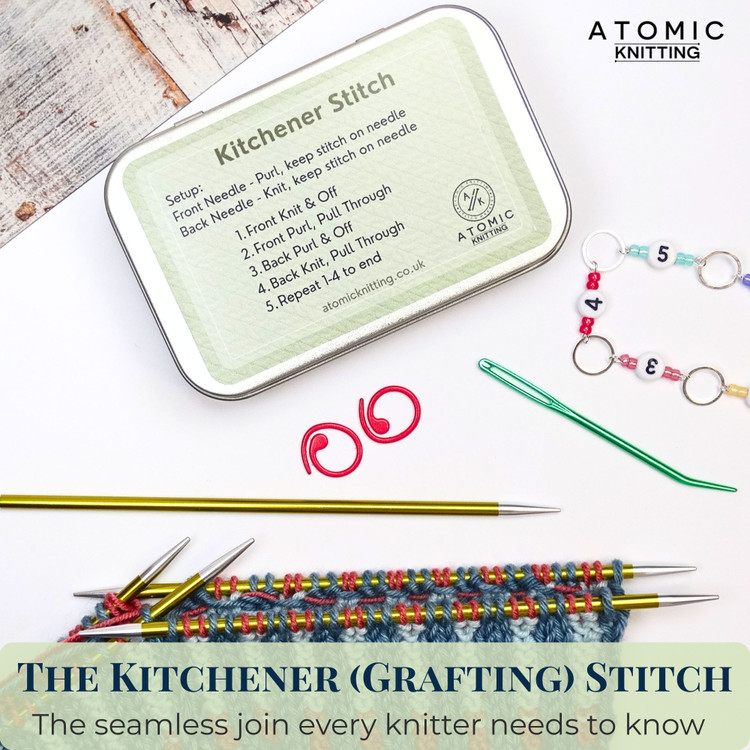
Our Grafting Stitch Instruction Tin is designed exactly for this — a small, hinged aluminium tin with the Kitchener stitch steps printed right on it, so you always have the instructions to hand without hunting through pattern books or scrolling through your phone or tablet. It also doubles as a lovely little notions tin for keeping your finishing tools together in one place. More on that below.
How to Work the Kitchener Stitch: Step by Step
Set up with an equal number of stitches on two parallel needles. The yarn tail should be coming from the right end of the back needle.
Thread your yarn onto a tapestry needle.
Step 1 - Setup (worked once only):
- Front needle: insert tapestry needle into first stitch as if to purl, pull yarn through, leave stitch on needle
- Back needle: insert tapestry needle into first stitch as if to knit, pull yarn through, leave stitch on needle
Step 2 - The repeating sequence (work this for every stitch until the end):
- Front needle: insert tapestry needle into first stitch as if to knit, pull yarn through, slip stitch off the needle
- Front needle: insert tapestry needle into next stitch as if to purl, pull yarn through, leave stitch on needle
- Back needle: insert tapestry needle into first stitch as if to purl, pull yarn through, slip stitch off the needle
- Back needle: insert tapestry needle into next stitch as if to knit, pull yarn through, leave stitch on needle
Repeat this four-step sequence until one stitch remains on each needle, then work the setup steps in reverse to close off.
Gently tug the yarn every few stitches to keep the tension consistent - not too tight, not too loose. You're aiming to match your knitting tension as closely as possible.
Tips for Getting It Right
Don't rush. The Kitchener stitch rewards a calm, methodical approach. Put on something good to listen to and take your time.
Check your tension as you go. It's much easier to adjust tension stitch by stitch than to try to even it out at the end.
Use a contrast colour to count. If you're nervous about keeping track, place a stitch marker between every set of 10 stitches before you start grafting. It gives you checkpoints and stops the stitches blurring together.
Keep the instructions visible. This sounds obvious, but it makes a genuine difference. If you're pausing to look something up mid-graft, you lose your rhythm and your place. The Grafting Stitch Instruction Tin is ideal for this — it sits open on the table beside you, no scrolling, no squinting at a book.
Work in good light. You need to see clearly which needle you're on and which direction your tapestry needle is entering the stitch.
The Mnemonic That Helps
Many knitters find this phrase useful for remembering the sequence:
"Knit off, purl on; purl off, knit on."
- Front needle: knit off (remove), purl on (stay)
- Back needle: purl off (remove), knit on (stay)
It doesn't cover the initial setup, but once you're in the rhythm of the main sequence, it keeps you on track.
Why Knitters Avoid It (And Why You Shouldn't)
The Kitchener stitch has a reputation that's bigger than it deserves.
The reason most knitters dread it is simple: they only do it occasionally, so every time feels like learning it from scratch. The solution isn't to avoid it - it's to make the instructions genuinely accessible. Once you have them somewhere reliable, the stitch itself becomes just another part of finishing.
And the finish really is worth it. A grafted toe on a sock looks completely professional. A grafted shoulder seam on a handknit jumper gives it a quality that folded seams simply can't match.
What to Keep in Your Grafting Kit
If you do any amount of sock knitting or seamless garment knitting, it's worth having a small dedicated kit for finishing:
- A blunt sew-up needle
- A few stitch holders or a knitting stitch cord for holding live stitches safely
- A small pair of scissors or yarn cutter
- Your Grafting Stitch Instruction Tin — which can hold all of the above!
Keeping everything together means you're not hunting for a tapestry needle when you should be finishing your sock. There's nothing more anticlimactic than completing a project only to spend twenty minutes searching for the right needle.
The tin is also a lovely thing to own. It makes finishing feel like a proper ritual rather than a chore.
A Note on Counting Stitches Before You Graft
One thing that trips people up: arriving at the toe grafting stage only to discover an uneven number of stitches on each needle. The Kitchener stitch requires equal numbers on both needles, so it's worth counting before you start.
If you use a row counter throughout your sock knitting, you're much less likely to end up in this situation - you'll have kept careful track of your decreases and know exactly where you are. Our post on row counters covers everything you need to know about using them well.
Stitch markers are also useful during the decrease rounds leading up to the toe - placing markers on either side of the instep stitches means you always know exactly which stitches belong on which needle.
Ready to Give It a Go?
The Kitchener stitch is one of those techniques that rewards you disproportionately for learning it. One afternoon of focused practice and you'll have it for life.
Start with a small swatch if you're nervous - cast on 12 stitches, knit a few rows, divide evenly onto two needles, and practise the graft with contrast yarn before you attempt it on a real project.
And keep the instructions to hand. Every time.
Shop the Grafting Stitch Instruction Tin
Browse all Knitting Accessories
Read: Row Counters — The Secret to Stress-Free Knitting
Atomic Knitting has been making stitch markers, row counters and knitting accessories in South Wales since 2006. Everything is designed and handmade by Emma in her bead studio.